If you want to see how impotent capitalism is to deal with difficult times, compare it with Cuba in its ‘Special Period’…
How Cuba dealt with economic disaster
WORKERS, JANUARY 2009 ISSUE
|
| Small country, powerful ideology: Marxism enabled Cuba to survive a 40 per cent drop in production. |
Without a working class alternative to capitalism, there is the probability that we will get dragged down with capitalism and face disaster. Such alternatives do not magically appear. They must be fought for by workers and they will come about only by a working class taking responsibility for its own future. It may sound a hard thing to do but there are examples of workers taking responsibility for their own future that we can learn from.
So how have other workers dealt with economic crises and calamity? Let’s look at the Cuban experience, which, because of our links with Cuban trade unions, we are in a position to examine.
The history of Cuba during the Special Period is of the highest level of the Dictatorship of the Proletariat in a country that is impervious to the Credit Crunch and the recession, just as the Soviet Union was impervious to the effects of the Great Depression during the 1930s. Following the collapse of the Soviet Union and the East European bloc around 1990, Cuba’s economy went into free fall and its economy shrank by a massive 40 per cent. (And our government is worrying about 0.5 per cent!). It was no longer able to import oil and oil products, machinery and spare parts, foodstuffs from wheat and rice to frozen chicken and cooking oil, medicines and anaesthetics, chemicals for production of tyres, soap and detergents, timber and wood pulp for making paper, shoes and clothing, vehicles and power station equipment, water treatment chemicals and disinfectants, white goods and TVs, and cement and construction materials.
His master’s voice
All this disappeared overnight as the new Russian President Yeltsin banned all trade with Cuba at the request of his new masters in the White House in Washington. Yeltsin, of course, went on to give away the assets of the Russian working class to the new breed of gangsters running the country. Cubans could see what was happening in Russia and could see what would happen to their country if they did not take charge of the situation they faced.
Cuba also lost the market for its main produce – sugar – and the US tightened up its blockade of the island with the Torricelli Act and the Helms Burton laws in an attempt to starve Cubans into submission and bring down its socialist system. These laws were intended not just to ban US companies from trading with Cuba, but to make it illegal for foreign companies to trade with Cuba, and to encourage illegal and dangerous emigration from Cuba. Cuba and the US signed a migration treaty permitting 20,000 Cubans to migrate to the US annually. The US never honoured this agreement, issuing only 1,000 visas a year but promising any Cuban who made it to the US illegally automatic US citizenship.
The US, that had already used low-level biological warfare against Cuba, spreading animal and plant diseases and human blindness, now sponsored terrorism against Cuba. Some 3,500 were killed during mercenary attacks, the bombing of an aircraft and bombs in Cuba, all initiating from the US. Five brave Cubans who volunteered to infiltrate the mercenary organisations to put a stop to this activity and who tried to pass on information to the US authorities about possible terrorist attacks against Cuba from US soil were jailed for long sentences for their trouble. The US and its counterrevolutionary allies in the US boasted of Cuba’s imminent collapse.
In this situation, special Congresses of the Cuban Communist Party and mass organisations of the people such as the trade unions (CTC), the Union of Communist Youth, the Committees for the Defence of the Revolution and the Cuban Federation of Cuban Women were convened, and the Cuban working class confronted the situation that they faced.
Rationing was introduced, and foreign investment was sought to develop tourism as the only short term way they could obtain hard currency to buy the goods they needed to survive. The government declared that there now existed a Special Period outside of war.
By 1993, Cubans were hungry as food imports disappeared and there were daily electricity blackouts. There was little transport or fuel and unemployment was rising. However, after the Congresses, the working class through their organisations took control of the situation.
The CDRs, the Committees for the Defence of the Revolution, are local neighbourhood committees that defend the values of the revolution. During the Special Period they also took care of their local communities and made sure that no one fell through the safety net, while the trade unions looked after their class in a number of ways despite the fact there was very little for their members to spend their wages on.
Union farms
Trade union farms were opened to grow food. The health workers’ union looked after the health of the people and the infrastructure of the health system. The transport union looked after the transport system to keep it ticking over. The education and science union maintained educational standards despite lack of equipment, and supported pioneering developments in biotechnology and genetics. Innovation was the word as workers found ways to get around the problems arising from the blockade. The Institute of Innovators and Rationalisers was set up to identify solutions to the myriad of problems.
Cuba also had to address its security concerns. Faced with the constant threat of invasion by the USA, Cuba had relied on its relationship with the Soviet Union to deter such an attack. Now this would have to change. Cuba would have to rely on its own ability to defend itself. Cuba learned from the Vietnamese experience, the lessons of developing a strategy of a “war of all the people”. This meant that the whole population would have a role in the defence of the country.
Union armouries
Trade unions had their own armouries. Previously, their watchword had been that the enemy would never step foot on the island. Now it adapted to defeating an invading army. Guerrilla struggle would be the theme for their defence. And of course they had experience from the revolution and the armed guerrilla struggle in the Sierra Maestra and other campaigns. They also had the experience of their soldiers fighting alongside Angolan troops and Namibian freedom fighters against South African invaders and US -backed troops that ended in victory for Angola, independence in Namibia and the collapse of the Apartheid regime in South Africa.
Then there were the Cuban volunteers who earlier fought alongside freedom fighters in Guinea Bissau and the Cape Verde Islands in a liberation war that brought about the collapse of the Portuguese empire and Portuguese fascism, and independence for Guinea Bissau, Angola and Mozambique. With these achievements there was good reason to believe in their own defence.
So the Special Period put Cuba on a wartime footing, not unlike our own Special Period during the Second World War. Despite severe hardship, there was a strong sense of class collectiveness and faith in the working class leadership. Tourism was developed as a source of foreign currency that the country lacked although all Cubans knew that this was not the long-term future of their country. Tourism brought with it a new range of problems such as the dual currency, which meant that those with access to hard currency were better off than those who had no access, and this had to be managed. By 2006, Cuba was able to introduce its own hard currency.
Despite the hardships, Cubans maintained their values throughout this period, training more doctors and teachers per capita than any other country, and offering scholarships to low-income students from Africa, Latin America, the Caribbean and Asia. As Cuban doctors and teachers practised in numerous poor countries, so Cuba’s standing in the world increased. African countries remembered Cuba’s role in their liberation struggles and the end of the South African Apartheid regime.
UN resolutions
Cuba would put an annual resolution to the General Assembly of the United Nations condemning the illegal US blockade of Cuba and calling for it to be lifted. More and more countries supported the Cuban resolution each year until this October 2008 when the vote was 185 countries supporting Cuba with only Israel and tiny Palau supporting the US. The US continues to ignore the UN resolution but its moral authority declines with each annual vote. Incidentally, one of the architects of the US blockade is the new Vice President elect of the USA, Joe Biden.
But the US responded to this in another UN body. Each year it would press one of its subordinate countries – maybe the Czech Republic or El Salvador or Uruguay – to raise complaints about human rights in Cuba to the UN Commission for Human Rights. Each year the US would win this until eventually one country – Uruguay – refused to be a US pawn and other countries complained that the US was using the Human Rights Commission as a political tool. The US was voted off the Human Rights Commission and was replaced by Sudan – a humiliation for the US. Today the Human Rights Commission has been upgraded so that it cannot be used as a US political tool, and a Cuban is the current chairman.
|
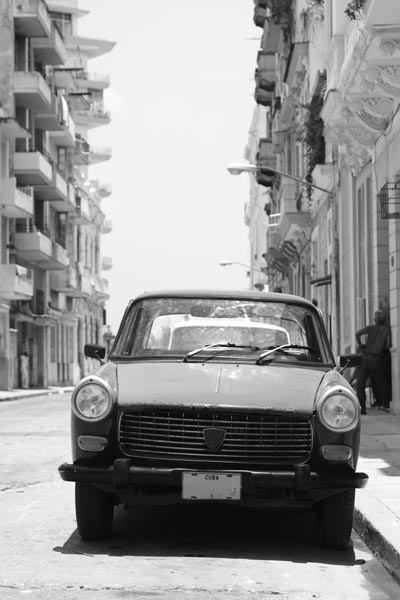
| Old car in Havana: nothing is wasted. |
Then in 2000, Cuba embarked on its Battle of Ideas, a nationwide campaign to reassert and develop working class socialist values. This Battle of Ideas was carried into schools, among youth organisations, trade unions etc.
The Battle of Ideas gave birth to a new occupation called a “social worker”. New training schools for social workers were opened, and this new worker was not only to work in support of families and children as we would understand the job. The social workers, mainly young and from poor families, were to visit every family and individual, learn all of the specific problems facing different groups – families, single mothers, unemployed, children, pensioners – and find solutions for them. 28,000 had graduated by 2005.
They then moved on to tackle the corruption that developed during the Special Period, just like it developed during our Special Period during WWII with spivs and the black market. First they tackled the petrol stations where fuel had been siphoned off and sold, denying revenue to the state. 10,000 of them took over the pumps at every filling station in the country and accompanied delivery drivers, monitoring the refineries. In two months, the state’s income from petrol stations doubled.
We have heard these youngsters described as “Doctors of the Soul”. They are a part of the process of guiding the society towards the strengthening of socialism as the economy recovers. They are the next generation of revolutionaries and are the revolution’s shock troops.
Today, the Special Period is officially over and the economy has turned the corner, GDP is expanding at between 4 and 9 per cent a year, and the Battle of Ideas continues as socialist, honest, humanitarian values are asserted. This was only achieved by the Cuban working class because it holds state power and because of its work through its organisations taking control of the situation, by taking responsibility for the consequences of the blockade and taking responsibility for the future and future generations.
In fact it can be argued that Cuba is the most responsible country in the world with 40,000 Cuban doctors in 72 countries saving millions of lives, educationalists abolishing illiteracy around the world, and by minimising its reliance on fossil fuels with a dramatic energy saving programme born out of necessity. Because of the respect it has gained, Cuba can have good relations with countries that you would have thought impossible. For example, Marxist Leninist Cuba can have excellent relations with Islamic Iran.
Fighting hurricane
During the recent three devastating hurricanes Fay, Gustav and Ike that hit Cuba in September causing $8billion worth of damage, it was the working class through its organisation that saved lives and worked selflessly and collectively to repair the damage and care for those who lost homes and property, under the slogan “every human life is sacred”. (For the full story of the hurricanes read October’s edition of Workers.)
The Cuban Civil Defence Authority takes responsibility for the population in events such as hurricanes. They actually guarantee to save all lives if people and organisations do as instructed. The same three hurricanes hit neighbouring Haiti and over one thousand were killed and many are still without food. In Cuba seven people died. When we expressed our condolences during our recent visit, we were respectfully told that the seven had ignored instructions from the Civil Defence Authorities. In the event of hurricanes, everyone is mobilised through trade unions and other mass organisations.
Such achievements as Cuba’s can only be realised by the disciplined and determined action of organised workers. There is no other way they could have done it.
This article is based on extracts from a speech at a meeting organised by the Communist Party of Britain ML at Conway Hall, London, in November 2008.