Over-running engineering works, chaos on the tracks, buses instead of trains: privatisation is delivering everything its opponents said it would – and a lot more...
Railways: struggle ahead on the line as bungling employers look for more profit
WORKERS, FEB 2008 ISSUE
The failings of the nation's fragmented and privatised railway were highlighted over the Christmas period as major engineering works overran, and huge fare increases were announced. Network Rail, brought in to overcome the chaotic and dangerous situation on the tracks after privatisation, has failed to deliver thanks to its continuing reliance on the contracting system condemned after the Hatfield and Potters Bar crashes.
Network Rail closed the West Coast Main Line for 8 days as new track, signalling, and overhead electric wires were installed at Rugby. The work was originally scheduled over 4 days, with this vital route to the Midlands, the North West and Scotland reopening on New Year's Eve, a particularly busy day as people travel to relatives and friends for New Year celebrations.
Just 24 days before, having taken huge numbers of bookings for their trains, Virgin were told that Network Rail would need another day, and the route would remain closed. Passengers would be put on buses around the closure, adding up to 2 hours on their journeys. Virgin made a complaint to the Office of Rail Regulation. At 3pm on 31 December, Network Rail announced that the work wouldn't be finished on time, and it was not until 3 January that any indication was given of when the line would reopen.
Network Rail does not employ engineering workers for such operations. Instead, nine contractors were involved, and all nine reportedly were intending to use the same few casuals and agency staff to do the work! In desperation, Network Rail then rushed in its own maintenance staff to get the job finished.
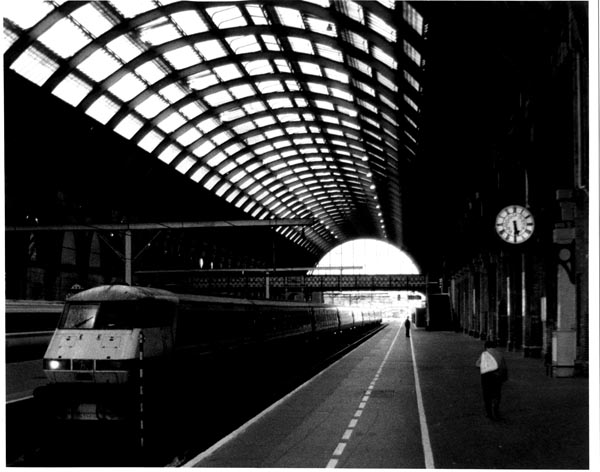
Platform 1, King's Cross, London. The train is owned by one company, the track by another, and the station by yet another company...
Photo: WorkersFiascos
Meanwhile, London's Liverpool Street station was also closed for an extra day, with workers attempting to get back to their Central London jobs on 2 January finding that the trains weren't running. The same problem, a lack of staff, was blamed, and no wonder – some staff had been redeployed to Rugby!
Network Rail has been telling everyone who will listen that they want to be a "world-class railway". Industry insiders have instead called the problems over Christmas as a "world-class cock up". These fiascos followed the announcement a few days earlier that Network Rail's chairman, Ian McAllister, had been knighted "for services to the transport industry" – and that passengers were going to have to pay up to 10 per cent more on fares.
Network Rail has already been fined £2.4 million for the failure to complete on time a major resignalling scheme at Portsmouth over the previous Christmas, and it is expected that the Office for Rail Regulation will levy a much greater fine this time. Train companies like Virgin will also be seeking large sums in compensation, although only some of this will find its way to passengers inconvenienced by the line closures.
Contractor culture
The unions have condemned the contractor culture that Network Rail continues to perpetuate. Network Rail has seen the clear advantages of having taken maintenance off contractors four years ago, running it themselves. Senior managers are now making noises (belatedly) about ditching contractors and doing the track renewals "in house". However, even if the company does act, it will still be using contractors for other work, including signalling renewals.
Whatever Network Rail does, it cannot escape responsibility for the overruns. There has clearly been an issue with planning both major renewal projects and maintenance over many years, and it seems that this was at the root of the problems. It doesn't help that significant numbers of skilled staff whose roles were related to planning and project management were got rid of over the last few years.
Indeed, Network Rail's management of maintenance over recent times has been woeful. The derailment of a Virgin train in Cumbria last year revealed major problems of management, so much so that safety watchdog HMRI has served an improvement notice on the company instructing it to get things sorted out.
Staff working in Network Rail are under enormous pressure to produce results, partly driven by a universally hated performance-related pay system, and partly by a bonus system which rewards directors with huge six-figure sums, while the workers' meagre bonuses are withheld by the company at the slightest excuse.
An attempt to withhold bonuses in Scotland from signallers who had the temerity to take strike action when the company failed to honour agreements was firmly rebuffed by RMT. The staff working on maintenance in the Cumbria area also had bonuses withdrawn after the derailment there, but the directors, who have ultimate responsibility for what took place, were quite happy to pay themselves their mega bonuses, and some held back only after union pressure.
Safety culture
Network Rail's staff are often forced into making a decision between safety and keeping the trains running. They are under enormous pressure to keep the job going, but if things go wrong, the company immediately looks for scapegoats at the lowest level, as a means of deflecting blame from senior managers.
The passenger train operators had a change around at the beginning of November. Bus firms National Express, Go-Ahead, Arriva and Stagecoach all gained new franchises. There seems to be an endless merry-go-round where bus companies lose here and gain there, while the same old faces are recycled around the senior positions. This is throwing balls in the air for them to come down in a different configuration to no particular good, and at great cost to the taxpayer.
Highlighting this madness, unions have called for all trains to be painted the same colour so that we can all at least save on the expensive paint jobs that inevitably follow refranchising when trains change hands!
Foreign owners
Two new firms have entered the fray. MTR, which runs the Hong Kong metro, owns 50 per cent of the private company now running local services in London, now dubbed London Overground and under the control of Mayor Livingstone.
The other is DB (German National Railways), itself subject to privatisation as a result of EU diktat. DB has already purchased EWS, the biggest freight train operator, and is rumoured to be the hot favourite to buy Chiltern Trains and Laing Rail's interests in London Overground. So London will have its local trains run by the Chinese and the Germans.
The government continues to shy away from tackling the fundamentals of a fragmented private rail network that continues to fail the nation's transport needs, partly because it insists on slavish adherence to EU rules that require so-called "liberalisation" and privatisation of railways across Europe.
Challenges
The forthcoming year will doubtless see the railways as an industrial battleground. The future of the industry pension scheme, the insistence by government that public sector workers should accept paltry pay rises, and the attempt by many companies including Network Rail to introduce worse pay and conditions packages for many rail staff will be big challenges.
But the rail unions are strong, and well able to defend themselves. The RMT has a good class-based understanding of the relationship between the EU and the problems experienced in the rail industry. It has been consistent in calling for a referendum on the EU constitution.
With the roads filling up, and the railways seeing huge increases in use by both passengers and freight, the scene is set for an interesting year of struggle ahead.